Information is transferred manually more than once.
Solutions / 01 / AI Employees & Integration
AI employees that integrate into your business.
A clear task. Appropriate system access. Human responsibility.
An AI employee delivers value only when it can access the right information and work reliably with your applications. We develop custom AI agents from reusable templates and integrate them into your workflows with control.
Who we work for
For business leaders, IT managers and departments looking to automate recurring knowledge and administration tasks effectively.
Process and opportunity analysis
Description of a prioritized use case
Your starting point
When knowledge is scattered and routine takes up time.
We identify suitable tasks, define permissions and approvals, integrate interfaces and test the workflow under realistic conditions. We then support monitoring, maintenance and further development.
- Information is transferred manually more than once.
- Knowledge is scattered across ERP, CRM, email and documents.
- Routine takes time away from clients and specialist work.
Fewer manual handovers
Provide information where the next task takes place. We assess which handovers can be automated based on your actual process.
Reliable information for decisions
Base answers and suggestions on approved sources. Source references, defined follow-up questions and test cases help identify missing information and ambiguity.
Controllable automation
Define tasks, permissions and approval boundaries in advance. Responsible staff can trace what an agent processes and which actions it prepares or carries out.
What we contribute
From idea to a working process.
We tailor these building blocks to your project.
Process and opportunity analysis
We examine a specific workflow: triggers, steps, data sources, exceptions and responsibilities. This produces a focused use case and criteria for assessing value and quality in a pilot.
Agent templates & customization
Recurring agent patterns are adapted to your terminology, documents and working rules. We define what the agent may handle independently, when it asks questions and when it hands over to a person.
ERP, CRM, Microsoft 365, API and MCP integration
All NALVRA products support MCP. We connect them to compatible AI assistants using the Model Context Protocol. For each connection, we clarify available APIs and MCP functions, data fields, identities and access rights. Error handling and duplicate transactions are as much part of the design as the normal successful workflow.
Local models, EU cloud & hybrid architecture
Protection needs, response quality, data volumes and operating costs determine the architecture. Local models, suitable European providers and hybrid approaches are assessed for your specific use case.
Permissions, logging & approvals
Agents receive only the access they need. Write actions, confidential content and critical decisions are protected by appropriate approvals, traceable logs and defined responsibilities.
Operations, monitoring & optimization
Production use requires agreed responsibilities, testing when changes occur, interface monitoring and incident handling. Quality, model usage and costs are reviewed within the agreed operating scope.
Concrete use casesWhat this could look like
What this could look like
in practice.
Illustrative project scenarios show possible approaches. They are not documented customer references.
Prepare a customer inquiry for processing.
The starting point
An inquiry arrives by email. Customer records, previous transactions and product information are held in different applications; sales currently brings them together manually.
A possible approach
An agent could structure the request and missing details, query approved CRM and ERP data, and prepare a draft response with source references for the responsible person.
Possible outcome
The aim is a more complete working context with less searching and manual transfer. The pilot checks data assignment, response quality and handling of incomplete details, among other things.
Make service knowledge accessible from existing documents.
The starting point
Manuals, maintenance notes and internal solutions are scattered. Staff first need to identify which document version applies to the equipment or case.
A possible approach
A knowledge assistant could search approved documents, cite relevant passages and prepare a suggested answer. Document versions and permissions become part of the search.
Possible outcome
The aim is a traceable basis for further work. Testing covers typical questions, outdated documents, missing answers and access by different user groups.
Assign documents to a business transaction.
The starting point
Incoming documents are read, named and manually filed under a project or case. Inconsistent details lead to questions and incorrect assignments.
A possible approach
An agent could extract selected details, identify possible cases and suggest an assignment with reasons. Only clearly defined standard cases would be considered for automatic processing.
Possible outcome
The aim is more consistent intake with focused review of exceptions. Acceptance checks correct assignments, duplicate processing and unreadable files.
What integration can look like
From intake to an approved action.
An AI employee connects information and tasks. The workflow is adapted to your systems and permitted actions.
01Trigger
An inquiry, document or event starts a defined process.
02Context
Approved sources provide the required data under the intended access rights.
03Review
The agent prepares; rules and people decide on exceptions and critical steps.
04Action
A permitted action is executed or a reviewed suggestion is handed to the department.
Schematic integration model. System access, automation level and operating model are agreed for each project.
A transparent approachFrom the first conversation
From the first conversation
to a controlled outcome.
Each phase informs the next decision. Scope, responsibilities and acceptance are agreed before implementation.
- 01
Understand the process
With the department, we record the current workflow and choose a limited starting point. We document the situation, exceptions, data access and decision points.
Possible deliverableProcess map and defined pilot brief - 02
Configure agents
We define the task, sources, model selection and response behavior. Typical cases and undesirable results form the basis of an initial expert evaluation.
Possible deliverableTestable agent with test cases and approval rules - 03
Connect interfaces
Integration is first checked in a suitable test environment. We examine data quality, permissions, failure cases and recovery of interrupted workflows.
Possible deliverableVerified integration workflow with documented access - 04
Operate with control
Following agreed acceptance, use is approved step by step. Contacts, monitoring, change procedures and incident handling are part of the handover.
Possible deliverableOperating concept and traceable acceptance

Your starting point
AI Employee Opportunity Assessment
Bring a recurring process. We define a useful use case and clarify the data, approvals and interfaces needed for a pilot. Scope and effort are agreed before commissioning.
- Description of a prioritized use case
- Overview of data sources, access rights and outstanding prerequisites
- Proposal for a pilot, evaluation criteria and next steps
Software when it fits the need
Tools for your workflows.
Our own applications can complement delivery. Your requirements and actual interfaces are decisive; other suitable technologies are also considered.
 On request
Business & OperationsMCP-enabled
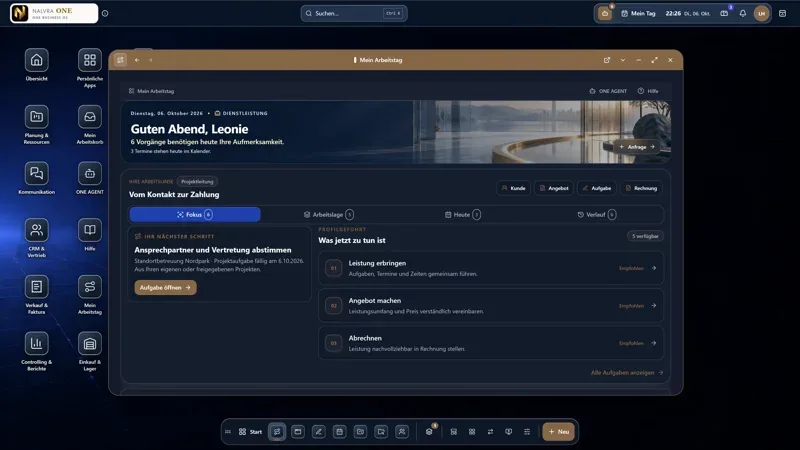
NALVRA ONE
The Business Operating System for small and midsize businesses.
View product External website · new tab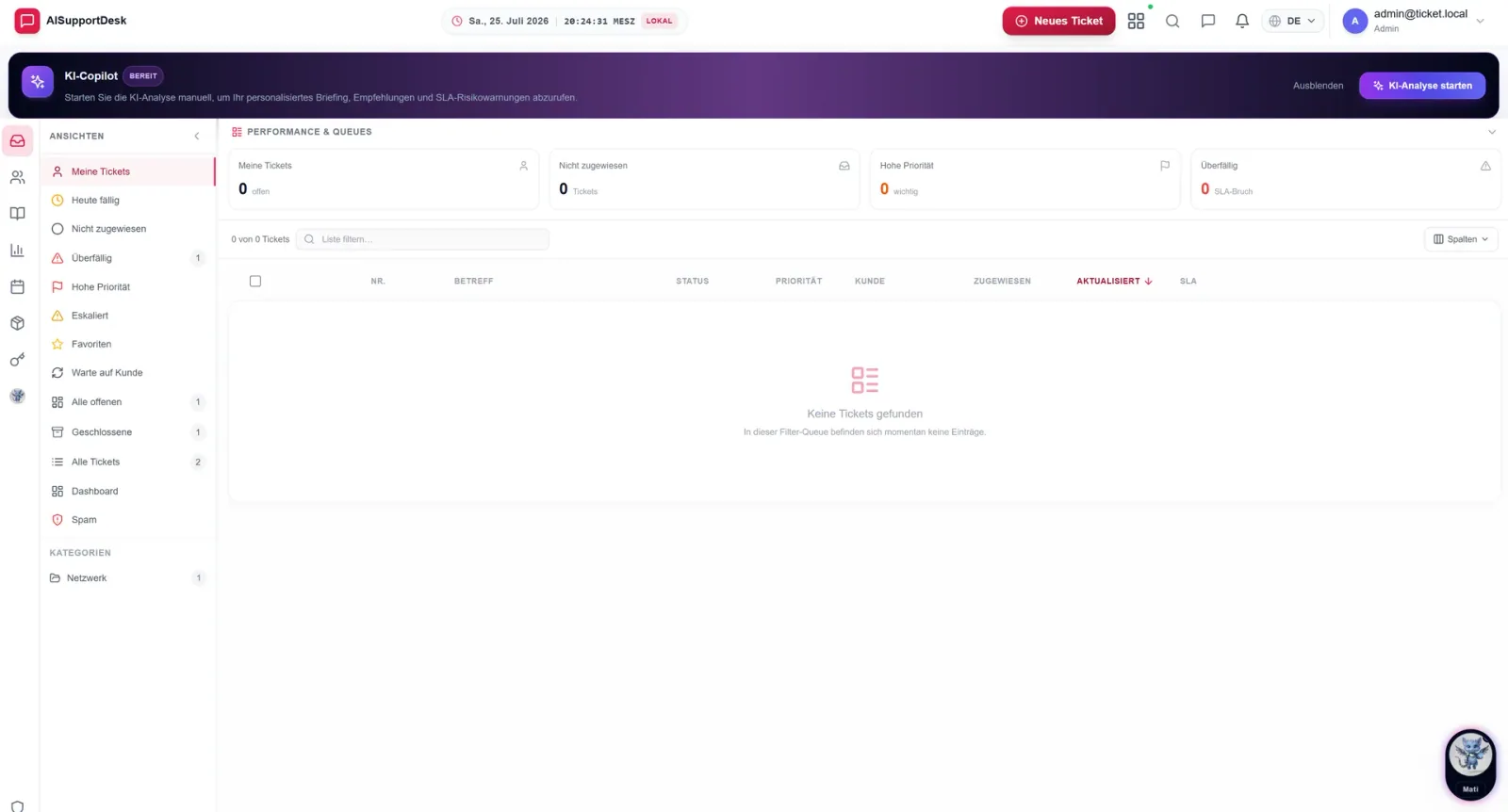 On request
Business & OperationsMCP-enabled
NALVRA SERVICE
Service and support platform for tickets, knowledge and technical resources.
View product External website · new tabSee the connectionsAnother perspective
Another perspective
can be worthwhile.
Questions before the first step
Useful questions. Clear answers.
Can existing applications be connected?
We assess the APIs, permissions and data quality of your existing systems. All NALVRA products support MCP and can connect to compatible AI assistants using the Model Context Protocol. The appropriate integration is defined in the project.
Can we use our own or local AI models?
Yes. Local, suitable external and hybrid architectures are assessed against protection needs, costs and operating requirements.
Can we start with a single process?
A clearly limited workflow is a sensible starting point. Goals, approvals and acceptance criteria are agreed before implementation.
Do we need an entirely new software platform?
You can start in your existing environment. Additional components depend on interfaces, protection needs and operations. Using a particular NALVRA product is not a prerequisite.
How do you handle incorrect or incomplete AI answers?
We plan explicit test cases, source references and handovers. Depending on risk, only suggestions may be allowed, or specific standard actions may receive limited approval. Quality is assessed against agreed tasks and reviewed when changes occur.
Your project. Our next conversation.
A good next step starts with clarity.
Describe your situation. We will discuss goals, technical prerequisites and a suitable starting point.