The original developers are no longer available.
Solutions / 03 / Legacy Modernization
Understand old software. Build its future.
Preserve proven business logic. Resolve technical dependencies.
When knowledge is lost, vendors stop support or business-critical applications age, modernization becomes a strategic task. We analyze functions and business processes and develop a suitable, maintainable successor.
Who we work for
For businesses whose specialist software remains critical despite technology, documentation or developer availability making continued operation difficult.
Discovery & inventory
Overview of the application, data and key dependencies
Your starting point
When the application remains but its knowledge disappears.
First, we map processes, data and interfaces. We then design and develop the new application, test it against defined business requirements and support data migration and a controlled transition.
- The original developers are no longer available.
- The application is important but technically difficult to maintain.
- Interfaces, documentation or a viable migration path are missing.
Recover knowledge
Systematically capture functions, data and exceptions in the legacy application. Implicit knowledge becomes a traceable basis for development.
Choose a viable path
Assess replacement, gradual renewal and continued operation against technical options and operational dependencies.
Make the transition manageable
Combine business comparison tests, verified data migration and a coordinated transition. Critical functions receive special attention before replacement.
What we contribute
Modernize instead of endlessly repairing.
We tailor these building blocks to your project.
Discovery & inventory
We review available source code, executable applications, databases, interfaces, operating environments and documentation. Users, their workflows and technical or legal limits of analysis are equally important.
Reconstruct business logic & requirements
With domain users, we reconstruct traceable rules, calculations, roles and exceptions. Observations become verifiable requirements; ambiguity remains visible as open issues.
Maintainable target architecture
We design a target structure suited to the use case, interfaces, protection needs and operating resources. Documented data models and a viable maintenance path inform technical decisions.
Development & business comparison tests
Delivery proceeds incrementally against agreed business test cases. Results from old and new applications are compared; deviations are investigated and assessed by responsible domain experts.
Data migration & parallel operation
Data is assessed for structure, quality and transferability. Test migrations, system reconciliation and possible parallel operation prepare the transition; fallback options are planned to suit the situation.
Documentation & controlled handover
Handover includes technical and business documentation, an agreed operating concept and traceable acceptance status. Maintenance, responsibilities and the legacy application's future are explicitly agreed.
Concrete use casesWhat this could look like
What this could look like
in practice.
Illustrative project scenarios show possible approaches. They are not documented customer references.
Replace an established manufacturing application.
The starting point
A local application supports production planning. Its original developer is unavailable; screens, calculations and exports contain business knowledge that is barely documented.
A possible approach
Representative orders and exceptions could be recorded with domain users. This provides documented requirements, comparison tests and a phased renewal concept.
Possible outcome
The aim is a testable successor with traceable business rules. The relevant process would move to the new application only after successful comparison and agreed acceptance.
Develop a spreadsheet and database solution further.
The starting point
Project information is held in an older database and several spreadsheets. Rules are distributed across formulas, macros and personal methods; parallel editing causes conflicting versions.
A possible approach
An analysis could connect data fields, roles and handovers and document critical rules. A limited new workflow would first be tested with sample data and selected users.
Possible outcome
The aim is a shared workflow with clear data ownership. Migration would assess data quality, mapping and business completeness through agreed samples and checks.
Connect a legacy application to a new system landscape.
The starting point
A specialist application serves its business purpose but lacks a suitable connection to a new ERP. Immediate full replacement would be hard to define and affect other processes.
A possible approach
Permitted export paths, data models and operational dependencies could first be examined. A defined interface or gradually replaced module could provide a limited modernization step.
Possible outcome
The aim is an assessable transition path: which functions remain initially, which data is transferred and where might later replacement make sense?
Business requirements as the common thread
From the existing workflow to a verified successor.
Modernization starts with understanding the business transaction. Technical delivery follows requirements against which it can be tested.
01Existing setup
Consider the application, data, interfaces and actual use together.
02Business rules
Describe calculations, exceptions and dependencies clearly.
03Comparison
Test the new implementation against defined cases and expected results.
04Transition
Connect data transfer, acceptance and cutover in a coordinated workflow.
Schematic modernization model. Reconstructability, permissions and an appropriate migration strategy are assessed in the project.
A transparent approachFrom the first conversation
From the first conversation
to a controlled outcome.
Each phase informs the next decision. Scope, responsibilities and acceptance are agreed before implementation.
- 01
Discovery
We examine the existing setup and usage by permitted means. Users, data, interfaces and operating dependencies reveal the actual application.
Possible deliverableInventory and dependency overview with analysis boundaries - 02
Reengineering
Observable rules and functions become requirements and test cases. A target architecture clearly defines the scope of modernization.
Possible deliverableBusiness requirements catalog and modernization concept - 03
Modernization
The new application or selected module is developed incrementally. Business comparison tests and human review accompany critical functions.
Possible deliverableTested software with documented comparison results - 04
Migration & handover
Data transfer and cutover are prepared and tested. Acceptance, responsibilities, operations and any parallel running are coordinated together.
Possible deliverableAgreed migration status and documented handover

Your starting point
Legacy Modernization Analysis
A structured starting point before commissioning a full rebuild. We clarify what is known about your application, which access is permitted and which functions are particularly important. Scope and effort are agreed separately.
- Overview of the application, data and key dependencies
- Assessment of open questions and possible modernization paths
- Proposal for deeper analysis, a pilot or next delivery steps
Software when it fits the need
Tools for your workflows.
Our own applications can complement delivery. Your requirements and actual interfaces are decisive; other suitable technologies are also considered.
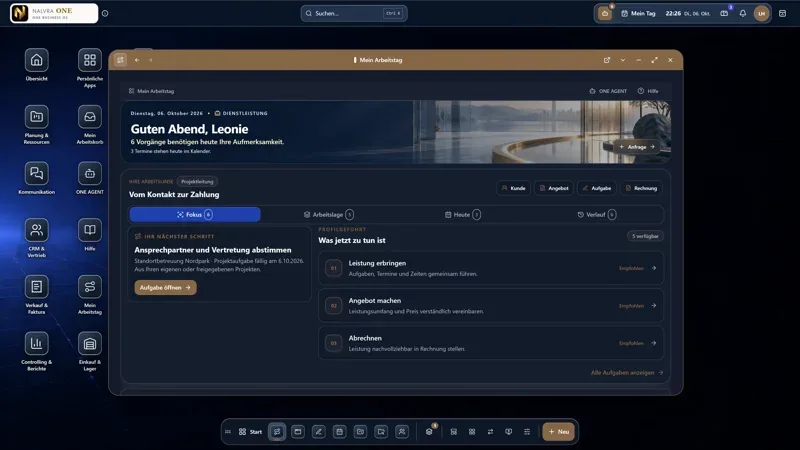 On request
Business & OperationsMCP-enabled
NALVRA ONE
The Business Operating System for small and midsize businesses.
View product External website · new tabSee the connectionsAnother perspective
Another perspective
can be worthwhile.
Questions before the first step
Useful questions. Clear answers.
Is the original source code required?
Source code makes analysis easier. Without it, we first assess which functions can lawfully be observed, documented and validated.
Must the old software be switched off immediately?
Gradual replacement and parallel operation can reduce risks. The right strategy depends on data, interfaces and operating requirements.
Can only part of the application be modernized?
Yes, if functions, data and interfaces can be meaningfully separated. Gradual renewal can ease the transition. Technical and economic suitability can only be assessed from the inventory.
What role does AI play in modernization?
AI-assisted tools can support analysis, documentation and development. They do not replace usage-rights reviews, business acceptance or tests. People review critical results; confidential data belongs only in approved environments.
Your project. Our next conversation.
A good next step starts with clarity.
Describe your situation. We will discuss goals, technical prerequisites and a suitable starting point.